Lifestyle
How to Create a Cozy Morning Ritual (And Why It Changes Everything)
The morning has a texture before it has a shape. Before the calendar fills in, before the first message arrives, before you’ve decided what kind of day it’s going to be — there is a window. Ten minutes, sometimes twenty. The quality of what you do inside that window has a way of determining everything that follows.
Most of us spend it looking at our phones.
A cozy morning ritual is the practice of spending that window differently — not productively, not efficiently, not in service of anyone or anything — but slowly, sensorially, in a way that reminds your nervous system that it is safe to begin the day gently. The Danes have understood this for centuries. They did not invent the slow morning, but they named what it gives you: hygge, the feeling of being exactly where you are supposed to be, warm and unhurried and briefly complete.
You don’t need an hour. You don’t need a beautiful kitchen. You need the willingness to treat the first moments of the day as if they belong to you — because they do.
Why the Morning Ritual Works
There is something almost physiological about the way a morning ritual changes the shape of a day.
When you wake and reach immediately for your phone, you are handing the first moments of your consciousness to whatever the world decided to put in front of you overnight. You begin reactive. You begin already behind. The nervous system, still soft from sleep, receives the jolt of notifications and news and other people’s urgencies — and it braces.
A ritual does the opposite. It gives the morning a predictable, gentle arc. The kettle, the light through the window, the particular mug you always use, the smell of whatever you’re brewing — these small repeated sensory anchors signal to the body that it is safe to ease in. That nothing is required of you yet. That you exist, this morning, simply as a person in a warm room with something good in your hands.
That feeling — earned slowly, through repetition — becomes the ground note of your entire day.
The Elements of a Cozy Morning Ritual
There is no single correct version. The ritual is yours, which means it should contain only what genuinely gives you pleasure, and nothing that feels like obligation. What follows are the elements worth considering.
Light First
Before anything else, change the light.
If you can, open a curtain and let in whatever the morning sky is offering — grey and soft, or pale gold, or the particular blue of very early winter. Natural light, even diffused, begins to regulate the body clock in a way that artificial light cannot replicate.
If the morning is dark, resist the overhead. A lamp, or a candle, or the small glow of the kitchen light over the stove — something warm and low. The quality of light in the first minutes of morning sets the entire atmospheric tone of the ritual. Make it something you’d want to linger in.
The Warm Drink
This is the center of the ritual. Everything else orbits it.
It does not need to be ceremonial or complicated. It needs to be made with a small amount of intention — the water at the right temperature, the right vessel, a moment of standing still while it steeps or brews. The act of making the drink is part of the ritual. The waiting is part of the ritual. The first sip, when it comes, is the threshold you step through into the morning properly.
Tea is the most naturally hygge of morning drinks — it requires patience, it rewards slowness, and there is an entire world of variation within it. A strong, malty black tea with a little milk on a cold morning. A floral white tea in early spring. A deeply warming blend of cardamom and ginger when the world feels heavy. Coffee, of course, is equally valid. The point is not the drink — it is the making of it, the holding of it, the sitting down with it before anything else begins.
The Unhurried Seat
Sit somewhere you like.
This sounds simple because it is, and because most of us do not do it. We make our coffee and drink it standing at the counter while loading the dishwasher. We carry our tea to our desk and begin working while it’s still too hot to drink. We consume the morning drink as fuel rather than as pleasure, which is a small but significant loss repeated three hundred and sixty-five times a year.
Find one seat in your home that belongs to the morning. A chair by a window. A corner of the sofa with a particular view. The back step if the weather allows. Bring your drink there, and sit in it, and do nothing useful for the duration.
This is not laziness. This is the practice of arriving somewhere before the day asks you to be everywhere at once.
Something for the Hands or the Eyes
After the drink is made and you are seated, the ritual wants one more element — something gentle for the mind to rest on without effort.
A book, physical and unhurried, read at whatever pace feels right. A journal, not for productivity planning but for the unfiltered thoughts that surface in the quiet of morning before the world’s noise crowds them out. A window to look out of. A plant that needs watering. A few minutes of music listened to properly, without doing anything else at the same time.
The point is engagement without demand. Something that asks nothing of you except your presence.
The Scent
This is the element most people forget and most reliably regret skipping.
The olfactory system is the most direct route to the limbic brain — the part responsible for emotion, memory, and the felt sense of being somewhere safe. A consistent scent in the morning ritual becomes, over time, a deeply conditioned cue for calm. Your nervous system learns to associate it with this particular quality of unhurried peace, and begins to drop into that state faster with each repetition.
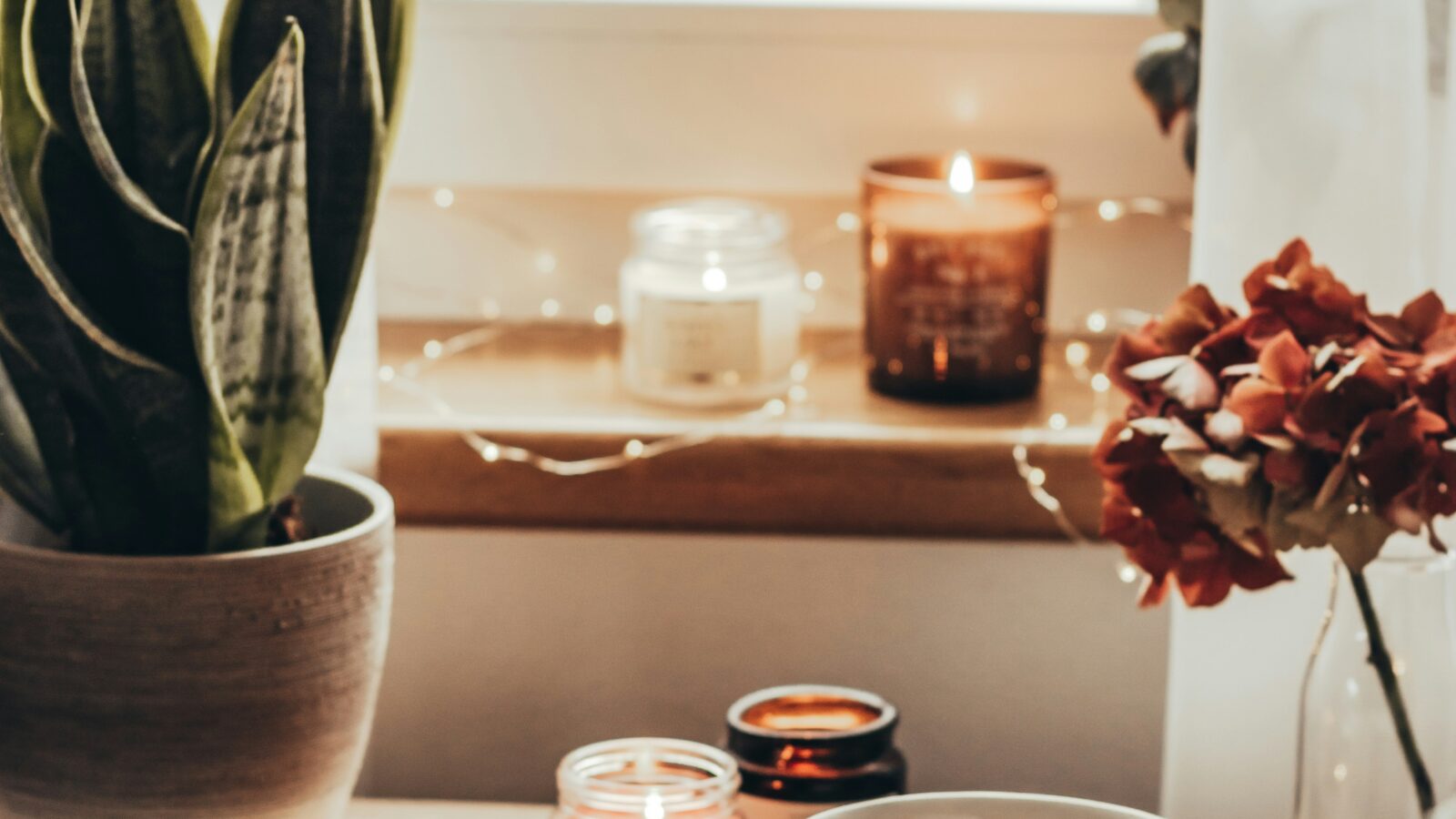
A candle lit only for the morning. A diffuser with something grounding — cedarwood, sandalwood, bergamot, clary sage. The smell of whatever you’re brewing. Pay attention to what your mornings smell like. Then make them smell like something you chose.
Building the Ritual: What Actually Works
The most common mistake is designing a morning ritual for the best version of your life rather than the actual one.
If you have forty-five minutes, use them. If you have twelve, use those. The ritual does not need to be long to be effective — it needs to be consistent and genuinely pleasurable. A three-minute ritual you actually do every morning will change your days more profoundly than an elaborate one you manage twice a week.
Start with one element. The drink, most likely — it’s the easiest anchor and the hardest to skip. Make it deliberately for a week. Sit down with it. Don’t look at your phone while you drink it. See what that one change does to the quality of your morning before you add anything else.
Then, if it’s working, add the light. Then the seat. Then the scent.
The ritual builds itself if you let it. One morning you light a candle without thinking about it. One morning you find you’ve been sitting by the window for twenty minutes and the day has not fallen apart without you. One morning you realize you have been doing this long enough that the smell of your morning candle, caught unexpectedly in a shop somewhere, makes you feel briefly, inexplicably, at home.
That is when you know the ritual has taken.
The One Rule
There is only one rule for a morning ritual, and it is not negotiable: no phone for the first twenty minutes.
Not to check the time. Not to read one thing. Not to send one quick message. The phone is the direct line to every anxiety, obligation, and piece of news the world is waiting to hand you — and the morning ritual is specifically the practice of postponing all of that long enough to remember, briefly, who you are when you’re not responding to anything.
Twenty minutes. The world will be exactly as you left it.
And you will be better equipped to meet it — warmer, quieter, more yourself — than you would have been otherwise.
The morning is yours before it is anyone else’s. Treat it accordingly.